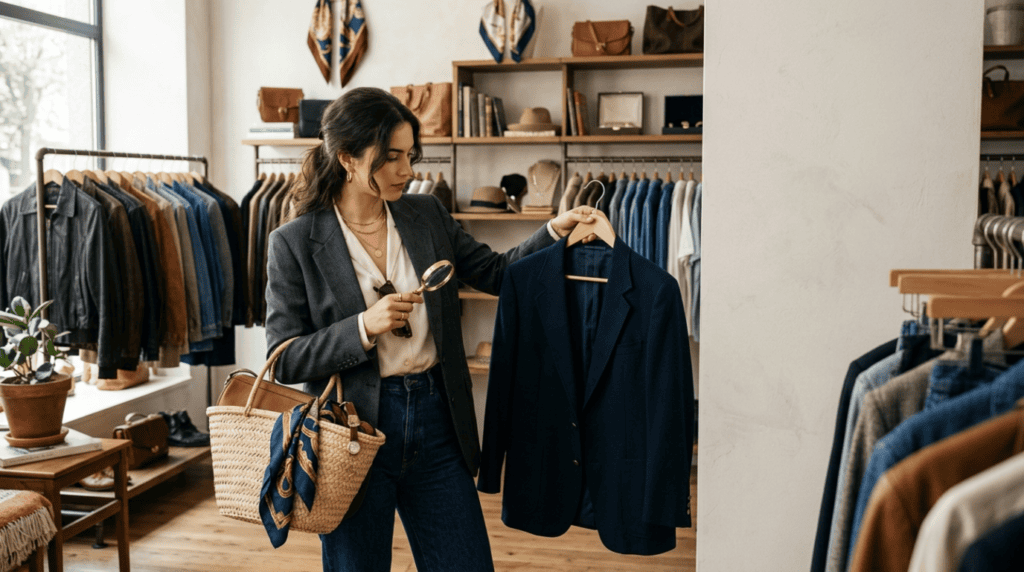
Walk into any Goodwill or Savers on a Saturday morning now and you’ll see it immediately: people with shopping lists, people filming for TikTok, people moving fast through the racks like they know exactly what they’re hunting for. Thrifting stopped being a backup plan a while ago. A recent ThredUp resale report found that 67% of shoppers now weigh resale value before they even buy something new, and 58% check secondhand stores before anywhere else. That’s not a niche habit anymore. That’s how a big chunk of people shop.
Which is also the problem. More shoppers means more competition, and more competition means the good racks get picked over fast. If you’re still judging clothes by whether you like the print or whether it fits, you’re going to keep walking out with fast-fashion castoffs instead of the vintage or designer pieces actually worth owning. The people who consistently find great stuff aren’t luckier. They just know what to check, and they check it in under thirty seconds per item.
Why Thrifting Got This Competitive
A few things collided at once. Reselling turned into a real side income for a lot of people, so resellers are combing racks before regular shoppers even arrive. Gen Z largely came of age treating secondhand as the default rather than the exception, not the backup plan. And home decor jumped on the same wave — grandmacore collectibles, vintage game tables, neoclassical accents — so thrift stores are getting picked through for furniture and knickknacks too, not just clothes.
None of that means good pieces are gone. It means you need a faster, sharper process than “does this look cool.” The shoppers still winning are the ones who can tell in seconds whether something’s actually well made or just old.
Fabric: The First Thing to Check, Every Time
Before you even look at the label, touch the fabric. Natural fibers — cotton, wool, silk, linen, real leather — are still the strongest signal of quality you’ll find on a rack. Synthetic blends are cheaper to produce, and it shows: they pill faster, lose shape, and don’t age well.
A quick trick that works on almost anything: stretch the fabric gently. If it snaps back into shape, it’s likely well constructed. If it stays stretched out or feels thin and flimsy, put it back. For jackets and structured pieces, hold the fabric up to the light near seams and stress points — thin spots there mean the garment is closer to falling apart than it looks.
Weight matters too. Denim should have real body to it, not feel like paper. Wool should feel dense, never limp. A cotton shirt should hold its shape at the collar and cuffs after you scrunch it a little. If a piece feels like costume fabric and it’s not supposed to be a costume, that’s your answer.
Stitching and Construction: Where the Real Story Is
This is the step most casual thrifters skip, and it’s the one that actually separates a keeper from a donation-bin reject. Turn the garment inside out and look at the seams.
Good construction shows up as straight, even, tightly spaced stitching with no puckering or gaps. Tailoring experts often reference stitches per inch as a rough benchmark — around 8 to 12 for outerwear and 14 to 18 for shirting. You don’t need a ruler for this. Just look for consistency. Sloppy, uneven, widely spaced stitches are a fast-fashion tell no matter what label is sewn in.
For jackets and coats specifically, feel between the outer fabric and the lining near the chest. Quality tailoring uses a floating canvas layer, usually horsehair or wool blend, that lets the jacket slowly mold to your body over time. Cheaper construction uses fused interfacing, which is essentially glued fabric that bubbles and separates after a few dry cleans. If you press on the chest and feel any stiffness that doesn’t move naturally with the fabric, that’s fusing, not canvas.
Check reinforced stress points too, especially at pockets, cuffs, and button plackets. Loose threads, uneven hems, or buttons attached with a single thread instead of a proper cross-stitch usually point to a lower-quality original garment, not just wear.
Hardware Tells You More Than the Label Does
Zippers, buttons, and clasps are an underrated giveaway. Vintage Talon zippers, along with established names like YKK and RiRi, are generally a good sign of quality manufacturing. Run the zipper up and down once. It should glide, not catch or stick.
Buttons matter more than people think. Metal shank buttons or thick, weighted plastic usually beat thin, hollow buttons that feel like they’d crack under pressure. If a garment has embroidery, embellishment, or a knit pattern, check the back side of it. On well-made pieces, that detail carries through cleanly on the reverse instead of looking like loose thread and glue.
Labels and Tags: Read Them Like a Detective
Tags tell you two separate things: authenticity and origin. A woven tag, where the lettering is actually created with thread, generally signals a higher-quality piece than a flat printed tag. It’s not a hard rule, but it’s a fast first filter.
Country of origin matters more than people expect. Labels reading “Made in Italy,” “Made in England,” “Made in Japan,” or “Made in USA” have historically tended to reflect higher construction standards, though there are always exceptions on both sides. Union labels, when you find them on genuinely older pieces, are a strong sign you’re holding something with real vintage age rather than a recent reproduction.
Speaking of reproductions, this is where a lot of newer thrifters get fooled. Genuine vintage wear shows up in specific, uneven ways — sun fading concentrated on shoulders or hems, elastic that’s lost its snap from age rather than use, stitching that’s weakened uniformly across the whole garment rather than in one convenient spot. Manufactured “distressed” looks tend to be too even, too deliberate, too symmetrical. If the wear looks staged, it probably is.
Fit Still Beats the Label
Here’s a test worth running on anything with a designer name on it: would you still want this if the tag were cut out? A recognizable label is exciting, but it doesn’t fix bad shoulder seams or a jacket that hangs wrong. Check that shoulders sit naturally without pulling, that the garment still looks intentional buttoned or zipped, and that any structure in the fabric is doing its job rather than sagging.
If a piece only works because of the name on the tag, keep looking. If it works with the tag removed, you’ve likely found something worth the trip.
What’s Actually Worth Hunting for in 2026
Some categories are genuinely having a moment right now, and knowing what to prioritize saves time on a crowded rack:
- Vintage outerwear and leather jackets — durable construction that ages well and holds resale value
- Real fur and faux fur pieces — a favorite among layering-focused shoppers building versatile wardrobes
- Grandmacore collectibles — vintage clocks, trinket dishes, jewelry boxes, and small figurines, if you’re shopping decor alongside clothing
- Vintage athleisure and academic-inspired pieces — cardigans, blazers in nature tones, and pieces that layer into an “old library” academic look
- Solid wood furniture and textile wall hangings — for anyone thrifting home goods, these are outpacing fast furniture in demand
None of these are guaranteed finds on any given trip, but they’re where the current demand is concentrated, so they’re worth prioritizing when you spot them.
Fixable Flaws vs. Walk-Away Flaws
Not every flaw should send a great piece back to the rack. Knowing which problems are worth the repair effort saves you from both overpaying for junk and passing on something genuinely good.
| Flaw | Verdict |
|---|---|
| Missing button, loose hem | Easy fix, worth buying |
| Small seam separation | Easy fix, worth buying |
| Light pilling on natural fiber | Removable with a fabric shaver, still worth it |
| Oil or ink stains | Often permanent, skip unless price is very low |
| Heavy pilling throughout | Signals cheap fabric to begin with, skip |
| Mildew or smoke odor | Rarely fully removable, skip |
| Shattered or brittle elastic | Costly to replace properly, usually skip |
| Peeling coated fabric (pleather, vinyl) | Cannot be repaired, skip |
Who Should Build a Thrifting Habit and Who Should Skip It
Worth it if you: enjoy the process, have time to check pieces properly, want a wardrobe with actual variety instead of trend-cycle basics, or care about buying fewer new, mass-produced items.
Skip it if you: need something for a specific event in the next few days and can’t afford the search time, or you consistently find yourself frustrated rather than having fun in the process. Thrifting rewards patience. If patience isn’t available right now, a curated resale app or consignment shop will get you there faster, even if it costs a bit more.
Final Thought
Thrifting in 2026 rewards specificity, not speed. Anyone can move fast through a rack. Fewer people know to flip a jacket inside out and check the canvas, or stretch a hem to see if it holds its shape. That thirty-second habit is the entire difference between a closet full of things you’ll actually wear for a decade and a bag of donations you’ll be dropping off again in six months.
FAQs
How can I tell if something is genuinely vintage and not just old-looking?
Check for uneven, natural wear patterns — fading concentrated on shoulders or hems, elastic that’s lost its stretch from age, and stitching that’s weakened consistently across the whole piece. Manufactured distressing tends to look too even and too deliberate.
Do woven tags always mean better quality?
Not always, but they’re a strong first indicator. A tag with lettering actually woven in thread generally points to a higher production standard than a flat, printed tag, though it’s worth checking construction too rather than relying on the tag alone.
Is thrifted clothing actually more sustainable?
Buying secondhand extends the life of an existing garment instead of creating demand for new production, which is generally considered a lower-impact choice than buying new, especially for fast-fashion alternatives.
What’s the single fastest quality check when I’m short on time?
Turn the garment inside out and glance at the seams. Straight, even, tightly spaced stitching with no puckering is your quickest signal, and it takes about five seconds per item.
Are designer labels worth paying more for at a thrift store?
Only if the piece would still hold up with the label removed. A designer name doesn’t fix bad shoulder seams, thin fabric, or a poor fit. Check construction and fit first, then let the label be a bonus rather than the deciding factor.