You’ve done this before. You swatch a foundation on the back of your hand, it looks perfect under the store lighting, and by the time you get to your car, your face looks like it’s wearing a mask. That’s not bad luck. That’s an undertone mismatch, and it’s the single biggest reason foundation looks wrong even when the shade name sounds right.
Undertone confusion is so common that most people who think they’ve “never found their shade” haven’t actually found their undertone. Once you know that, shade shopping stops being a guessing game.
What Is a Foundation Undertone, Exactly?
Your skin tone is how light or dark your skin looks, and it shifts with the seasons, tanning, and sun exposure. Your undertone is the color underneath that surface tone, and it stays the same your whole life, whether you’re pale in January or sun-kissed in July.
Foundation undertones generally fall into four groups:
- Warm – yellow, golden, or peachy base
- Cool – pink, red, or blue base
- Neutral – an even mix of warm and cool, leaning toward neither
- Olive – a golden-green base that’s often mistaken for warm or neutral
Getting this right matters more than getting the depth right. A foundation that’s slightly too light or dark can be softened with bronzer or a lighter powder. A foundation with the wrong undertone will always look slightly off, no matter how well it’s blended.
Why This Is So Easy to Get Wrong
Store lighting is usually cool and fluorescent, which flattens undertones and makes almost everything look “fine” in the moment. Phone cameras adjust white balance automatically, so a selfie swatch photo isn’t reliable either. And brand marketing doesn’t help: words like “golden,” “rosy,” or “natural” get used loosely, so two bottles labeled “medium” from different brands can have completely different undertones.
The fix isn’t more product. It’s a better test, done in the right light.
How to Find Your Undertone: Three Tests That Actually Work
Do these near a window in daylight, not under bathroom bulbs or ceiling lights. Artificial light shifts colors and gives false readings.
1. The Vein Test
Look at the veins on the inside of your wrist in natural light.
- Veins look blue or purple → likely cool undertone
- Veins look green → likely warm undertone
- Veins look blue-green or hard to categorize → likely neutral or olive undertone
This test works well for most people, but it’s genuinely tricky if you have olive skin, since olive veins can look green while still reading warm-neutral on the face.
2. The White Paper Test
Hold a plain white sheet of paper under your chin in daylight and look at your skin against it.
- Skin looks yellow or golden against the white → warm
- Skin looks pink or rosy against the white → cool
- Skin looks grayish or slightly green → olive
- No strong shift either way → neutral
3. The Jewelry Test
This one is quick, though it’s the least scientific of the three.
- Gold jewelry looks better on you → warm undertone
- Silver jewelry looks better on you → cool undertone
- Both look equally good, and your choice depends on the outfit, not your skin → neutral undertone
If two or three of these tests agree, you’ve got your answer. If they conflict, you’re probably neutral or olive, both of which sit in between the extremes and can genuinely go either way depending on the product.
Understanding Olive Undertones (The One Everyone Gets Wrong)
Olive skin has a golden-green quality that doesn’t fit neatly into “warm” or “cool,” which is why so many people with olive undertones end up buying the wrong foundation for years. Olive skin typically tans easily rather than burning, and it can look sallow or ashy in a foundation that’s straight-up warm or peachy.
The safest shade descriptors to look for if you suspect an olive undertone are “olive,” “neutral-warm,” or “golden” rather than “warm” or “peach” alone. In MAC’s shade naming system, for example, NC (neutral-cool) shades were built with olive and neutral-cool skin in mind, while NW (neutral-warm) shades tend to skew peachier and can look orange on olive skin.
If your face looks slightly gray or dull in a foundation you thought matched, olive undertone is worth considering even if the vein test pointed to “warm.”
Decoding Foundation Shade Codes
Once you know your undertone, shade labels become a lot easier to read. Most brands use some version of this system:
| Letter Code | Undertone | Common Shade Words to Look For |
|---|---|---|
| C | Cool | Porcelain, rose, cool beige, pink ivory, sable |
| W | Warm | Golden, honey, caramel, warm almond, butterscotch |
| N | Neutral | Ivory, buff, nude, natural, neutral beige |
| Olive-specific | Olive | Olive, yellow-green, neutral-warm with a golden cast |
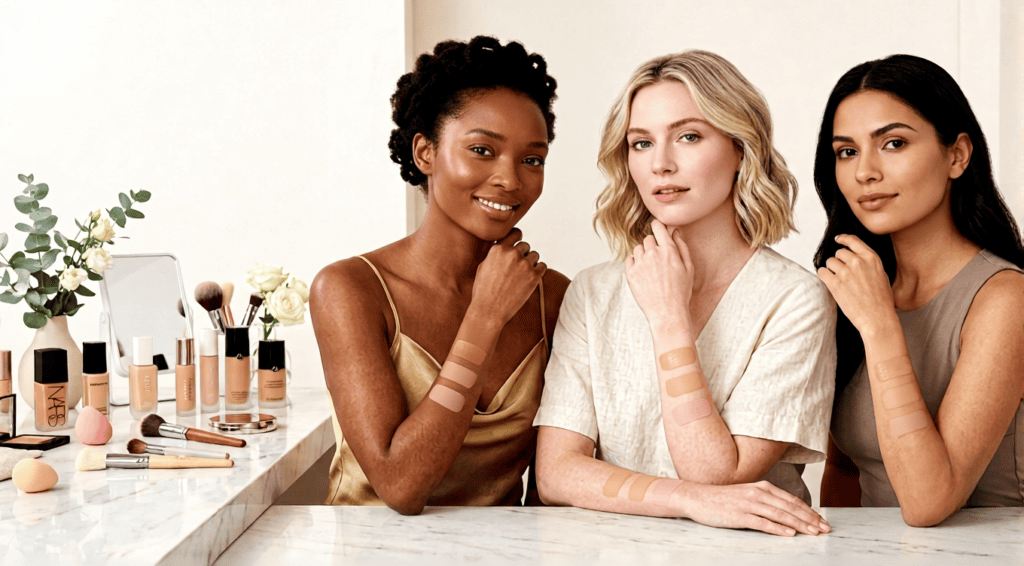
A quick rule that saves a lot of returns: swatch on your jawline, never your hand. Your hand and your face rarely share the same undertone, and jawline blending is the only test that shows you how a foundation will actually look on your neck and face together.
Matching Foundation by Undertone
If You’re Warm
Look for shades labeled golden, honey, or peachy. Avoid anything marketed as “neutral” or “rose” at the fair end of the spectrum, since a pink-leaning base will read gray against warm skin. Bronzer, blush, and eyeshadow in terracotta, coral, or warm brown tones will echo your natural undertone rather than fight it.
If You’re Cool
Look for shades labeled porcelain, rose, or cool beige. Steer clear of anything gold or peach-forward, which tends to oxidize into an orange cast within a few hours. Cool undertones generally look best with pink, berry, or blue-based red makeup shades.
If You’re Neutral
You have the widest range of usable shades, which is genuinely an advantage. Foundations labeled “natural,” “buff,” or “neutral beige” will usually work well. If you can’t find a true neutral in a brand’s lineup, mixing a warm and a cool shade in equal parts is a trick professional makeup artists use constantly, and it works just as well at home.
If You’re Olive
Look specifically for “olive,” “neutral-warm,” or shades with a stated yellow-green cast. Skip anything labeled simply “warm” or “peach,” since those run in the wrong direction and can look orange rather than natural. A satin or skin-like finish tends to suit olive skin better than a flat matte, which can emphasize any grayness in a mismatched shade.
Foundation Undertone Comparison Table
| Undertone | Vein Color | Best Jewelry | Foundation Words to Look For | Words to Avoid |
|---|---|---|---|---|
| Warm | Green | Gold | Golden, honey, peach, caramel | Rose, pink, cool beige |
| Cool | Blue/Purple | Silver | Porcelain, rose, pink ivory | Golden, peach, honey |
| Neutral | Blue-green/unclear | Both | Natural, buff, neutral beige | Strongly warm or strongly cool shades |
| Olive | Green (with gray-green skin cast) | Gold or mixed metals | Olive, neutral-warm, yellow-green | Peach, warm without qualifier, rosy |
Common Mistakes to Avoid
Testing on your hand instead of your face. Hands tan differently and rarely match your facial undertone.
Shopping under store lighting only. Always step near a window or door before buying. Most beauty counters will let you do this.
Assuming skin tone and undertone are the same thing. You can tan darker in summer and still have the exact same undertone you had in winter. Depth changes; undertone doesn’t.
Trusting camera swatches. Phone screens auto-correct color balance, which makes almost every shade look plausible on screen.
Buying a full-size bottle before a wear test. Foundation can oxidize and shift color a few hours after application. A sample or travel size worn for a full day is the only way to know for sure.
Frequently Asked Questions
How do I know if I have a warm or cool undertone?
Check your veins in natural light. Green veins usually mean warm, blue or purple veins usually mean cool. Confirm with the white paper test: a yellow cast against white paper points to warm, while a pink cast points to cool.
Can your undertone change over time?
No. Your undertone stays consistent throughout your life. What changes is your skin tone, which can get darker with sun exposure or lighter in winter.
What if my undertone tests give conflicting results?
That usually means you’re neutral or olive. Both sit between warm and cool, so a single test won’t always give a clean answer. Try a few different shade families on your jawline and see which disappears into your skin most naturally.
Is olive undertone the same as warm undertone?
No, though they’re often confused. Warm undertones have a golden or peachy base. Olive undertones have a golden-green base and usually need shades labeled “olive” or “neutral-warm” rather than plain “warm,” which can look too peachy.
Why does my foundation look fine in the store but wrong at home?
Store lighting is typically cool-toned and fluorescent, which can hide undertone mismatches. Natural daylight shows the true color of a foundation, which is why testing near a window before purchasing matters so much.
Final Thoughts
Finding your undertone isn’t a one-time beauty counter event, it’s a five-minute check you can redo anytime you’re unsure. Once you know whether you lean warm, cool, neutral, or olive, shade shopping becomes a matter of reading labels correctly instead of hoping for the best. Skip the store lighting, test on your jawline in daylight, and let your undertone, not the flattering name on the bottle, make the final call.