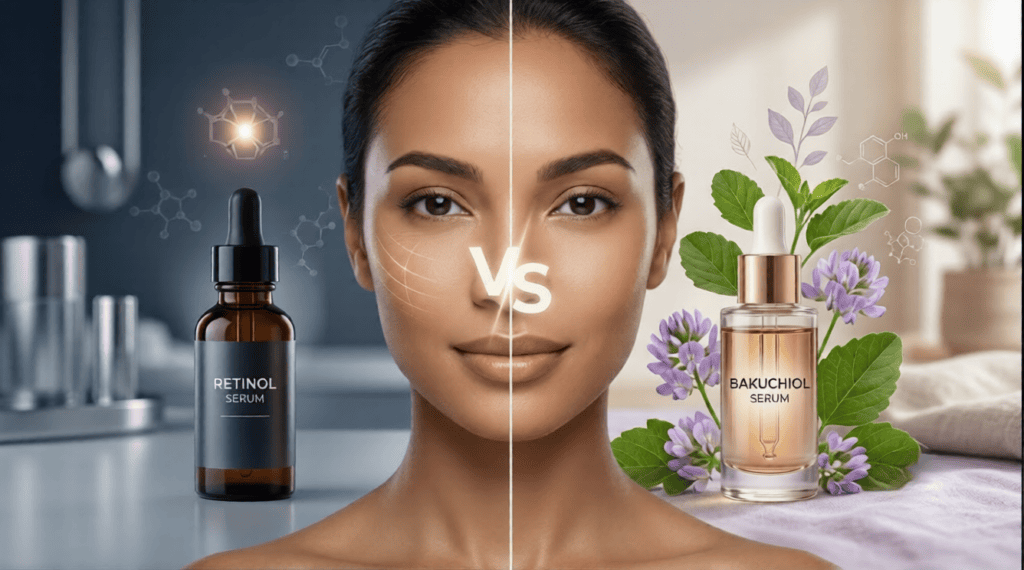
If you’ve spent any time browsing skincare shelves lately, you’ve probably noticed bakuchiol showing up next to retinol on almost every anti-aging serum. The pitch is always some version of “retinol results without the irritation,” and it’s tempting to just believe it and move on. But the real answer depends on your skin, not on which bottle has better marketing copy.
Both ingredients target the same concerns — fine lines, uneven tone, and loss of firmness — but they get there through different routes, and that difference matters more than most product labels let on.
What Is Retinol?
Retinol is a vitamin A derivative and one of the most studied ingredients in dermatology. Once it’s absorbed into the skin, it converts into retinoic acid, which binds directly to retinoid receptors in skin cells. That binding is what speeds up cell turnover, encourages collagen production, and gradually improves texture and tone.
This is also why retinol has a reputation for causing dryness, flaking, and that dreaded “purge” phase when people first start using it. The same mechanism that drives results is the one responsible for the irritation.
What Is Bakuchiol?
Bakuchiol is a plant-derived compound extracted from the seeds and leaves of Psoralea corylifolia, also called babchi, a plant long used in Ayurvedic and traditional Chinese medicine. Structurally, it has nothing in common with vitamin A — it’s classified as a meroterpene phenol, an entirely different type of molecule.
Despite that structural difference, research shows bakuchiol switches on some of the same downstream gene pathways as retinol, including the ones tied to collagen production, while also suppressing enzymes that break collagen down. It doesn’t need to bind to retinoid receptors to get there, which is part of why it tends to be gentler on the skin barrier.
What the Research Actually Shows
The most frequently cited head-to-head comparison is a randomized, double-blind trial published in the British Journal of Dermatology, which followed 44 patients over 12 weeks. One group used 0.5% bakuchiol twice daily, and the other used 0.5% retinol once nightly.
A few things stood out:
- Both groups saw comparable reductions in fine lines and hyperpigmentation, in the range of 20 to 30 percent
- The retinol group reported roughly three times more scaling, stinging, and dryness
- Nobody in the bakuchiol group dropped out due to irritation
It’s worth noting the dosing difference: bakuchiol needed to be applied twice a day to match retinol’s once-nightly results. That detail rarely makes it into marketing claims, but it’s a fair trade for a lot of people — especially anyone whose skin barrier can’t handle nightly retinoid use in the first place.
Later research, including smaller trials from 2019 and follow-up work in subsequent years, has pointed to additional benefits from bakuchiol, including improved skin firmness and better moisture retention, with antioxidant and anti-inflammatory properties as a bonus. Most of this research is still limited to 12-week windows, so long-term data — the kind retinol has decades of — simply doesn’t exist yet for bakuchiol.
Retinol vs. Bakuchiol: Side-by-Side Comparison
| Factor | Retinol | Bakuchiol |
|---|---|---|
| Source | Vitamin A derivative (synthetic or animal-derived) | Plant extract (Psoralea corylifolia) |
| Mechanism | Binds retinoid receptors directly | Activates similar pathways without receptor binding |
| Typical results timeline | 4–6 weeks | 6–8 weeks (often needs twice-daily use) |
| Irritation risk | Moderate to high, especially early on | Low |
| Photosensitivity | Increases sun sensitivity | Does not increase sun sensitivity |
| Pregnancy safety | Not recommended | Considered likely safer, though long-term safety data is limited |
| Clinical research depth | Decades of studies | Growing, but still relatively recent |
| Best suited for | Skin that tolerates actives well, deeper wrinkles, sun damage | Sensitive, reactive skin, first-time users, pregnancy or breastfeeding |
Who Should Choose Retinol
Retinol still makes sense if your skin already tolerates active ingredients without much fuss, or if you’re dealing with more advanced signs of aging like deep wrinkles or significant sun damage. It has the longest clinical track record of any anti-aging ingredient, and dermatologists generally consider it the benchmark that other ingredients get measured against. If you want the fastest, most well-documented results and you’re willing to introduce it slowly, there’s no strong reason to switch.
Who Should Choose Bakuchiol
Bakuchiol is the better starting point if you have sensitive or reactive skin, if you’ve tried retinol before and couldn’t get past the irritation, or if you’re pregnant or breastfeeding and need to avoid vitamin A derivatives altogether. It’s also a reasonable pick if you simply don’t want to deal with the adjustment period retinol usually demands. Just know you may need to apply it more consistently, and possibly twice a day, to see comparable results.
Can You Use Both Together?
Yes, and a lot of people do. A common approach is using bakuchiol in the morning under sunscreen, then retinol at night. This lets you get some of retinol’s stronger long-term benefits while giving your skin a gentler, antioxidant-supported start to the day. If you’re combining both, patch-test first and introduce retinol gradually, starting with lower concentrations two or three nights a week before increasing frequency.
Tips for Using Either Ingredient
- Always apply sunscreen the next morning, since even bakuchiol users benefit from SPF as part of a broader anti-aging routine
- Start slow with retinol — two to three nights a week initially, increasing as your skin adjusts
- Avoid layering either ingredient with strong exfoliating acids on the same night
- Store both away from direct light and heat, since active ingredients can degrade
- Give any routine at least 8 to 12 weeks before judging whether it’s working
Frequently Asked Questions
Is bakuchiol as effective as retinol?
Clinical trials show comparable reductions in fine lines and hyperpigmentation between the two, though bakuchiol often needs more consistent, twice-daily application to reach similar results.
Can I use bakuchiol and retinol together?
Yes. Many people use bakuchiol in the morning and retinol at night, which can reduce overall irritation while still getting retinol’s benefits.
Is bakuchiol safe during pregnancy?
It’s widely considered a safer option than retinol during pregnancy since it isn’t a vitamin A derivative, though long-term safety research is still developing. Check with your doctor before adding any active ingredient to your routine while pregnant.
Does bakuchiol cause purging like retinol?
No. Clinical research hasn’t shown the same purge phase associated with bakuchiol, which is one of the main reasons people with sensitive skin prefer it.
How long does it take to see results from retinol or bakuchiol?
Retinol users typically notice texture changes in around 4 to 6 weeks, while bakuchiol tends to take slightly longer, closer to 6 to 8 weeks, especially with once-daily use.
Final Thought
There’s no single winner in the retinol vs. bakuchiol debate — just a better fit depending on your skin. If your skin already handles actives well and you want the fastest, most clinically backed route to fewer lines and firmer texture, retinol still earns its reputation. If irritation has always been the dealbreaker, or you need something pregnancy-safe, bakuchiol gets you most of the way there without the drama. And if you can’t decide, you don’t really have to — using both at different times of day is a perfectly reasonable middle ground.