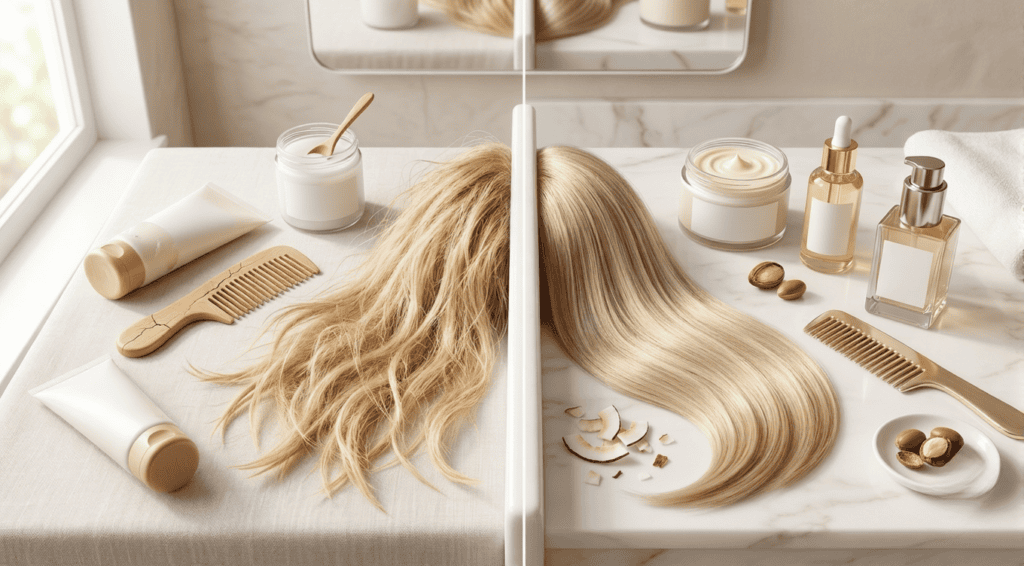
Bleach doesn’t just lighten your hair. It rips through the protein structure that holds each strand together, which is why bleached hair can go from smooth to straw-like in a single session. If you’re staring at dry, gummy, or breaking strands right now, you’re not imagining it, and you’re not stuck with it either.
The good news is that most bleach damage can be managed and visibly improved at home, provided you understand what’s actually happening inside the hair shaft and use the right products in the right order. This guide walks through exactly that.
What Bleach Actually Does to Your Hair
Bleach works by forcing open the hair’s cuticle and using a chemical reaction to break down melanin, the pigment that gives hair its natural color. That same reaction also breaks the disulfide bonds inside the cortex, the structural bonds responsible for your hair’s strength and elasticity.
Once those bonds snap, keratin is stripped away too. The result is hair that feels rougher, tangles more, stretches before it snaps, and loses its natural shine. This damage is chemical, not superficial, which is why a rinse-out conditioner alone was never going to fix it.
Some of this reaction is unavoidable. Even a careful, professional bleach job changes the internal structure of your hair. What you do in the days and weeks after determines whether that damage stays manageable or spirals into breakage and split ends.
The First 48 Hours After Bleaching
If you’ve just been bleached, resist the urge to wash your hair right away. Freshly bleached hair has a raised, porous cuticle, and washing too soon strips away the natural oils your scalp needs to start recovering. Waiting at least 48 hours before your first post-bleach wash gives your hair a head start.
During this window:
- Avoid heat styling completely
- Skip any additional chemical treatments, including toning at home
- Handle wet hair gently, since it’s at its weakest when saturated with water
Step 1: Figure Out Whether You Need a Bond Builder, a Protein Treatment, or Both
This is where most at-home routines go wrong. People reach for whatever “repair” product is on sale without knowing that bond builders and protein treatments solve two different problems.
A protein treatment works on the surface. It deposits hydrolyzed proteins, usually keratin, wheat, or silk, into gaps along the cuticle. <cite index=”16-1″>Protein treatments deposit hydrolyzed protein on the outside of the hair, filling cuticle gaps and giving a temporary stronger feel, but they wash off over four to six washes</cite>. That means the strength boost is real, but it’s temporary and needs to be reapplied.
A bond builder works from the inside. <cite index=”16-1″>Bond repair targets the broken disulfide bonds inside the hair shaft, the kind broken by bleach or heat, and rebuilds strength from within, with results that compound over weeks of consistent use</cite>. This is the category Olaplex, K18, and similar products fall into.
For bleached hair specifically, most stylists recommend leading with a bond builder and treating protein as a supporting player rather than the main event. <cite index=”17-1″>Most clients run bond builders, protein treatments, and deep masks on rotation without knowing which is doing what work, and the result is either over-treatment that leaves hair stiff and heavy, or under-treatment where the routine produces no real structural change</cite>. Overusing protein on already-fragile bleached hair is a common mistake that leaves strands feeling brittle instead of strong.
Quick way to decide:
| Your hair feels | Reach for |
|---|---|
| Stretchy, gummy, snaps when wet | Bond builder first |
| Rough, straw-like, but not overly stretchy | Light protein treatment |
| Both | Bond builder, then a light protein step a few days later |
Step 2: Use a Weekly Bond-Repair Treatment
At-home bond builders won’t match an in-salon service exactly, but consistent use makes a measurable difference. <cite index=”2-1″>Olaplex No. 3 is the at-home version of the brand’s in-salon repairing system, using bis-aminopropyl diglycol dimaleate to actively rebuild broken hair bonds, and is designed to undo the damage bleach and heat styling cause when used once a week</cite>. It’s worth remembering that this type of product is a repair treatment, not a moisturizer, so it needs to be paired with hydration separately.
Wella’s professional line takes the same approach with its own at-home step. <cite index=”4-1″>The WellaPlex N°3 Hair Stabilizer is a deep weekly treatment designed to reinforce the hair cuticle and keep strands strong between salon visits</cite>.
How to use a bond builder at home:
- Apply to towel-dried or dry hair, depending on the product instructions
- Comb through from mid-lengths to ends
- Leave on for the time stated on the packaging, usually 10 minutes to overnight
- Rinse and follow with a lightweight conditioner
- Repeat once a week during active recovery
Step 3: Deep Condition With Moisture, Not Just Protein
Bond repair rebuilds structure, but it doesn’t replace the moisture bleach strips out. This is where oils and humectant-rich masks come in.
Natural oils are genuinely useful here, not just a folk remedy. <cite index=”2-1″>Argan oil, avocado oil, coconut oil, olive oil, and almond oil are among the best options for repairing bleach damage</cite>, and you can layer them into either a store-bought mask or a DIY version.
DIY hair mask for bleached hair:
- Take two tablespoons of your chosen oil (or a mix of two)
- Blend in one egg yolk and a tablespoon of aloe vera juice
- Warm the mixture gently over a hot water bath, not the microwave, so it never gets more than lukewarm
- Apply to dry hair, saturating the ends
- Cover with a shower cap and leave for an hour
- Rinse with shampoo and lukewarm to cool water, since cooler water helps seal the cuticle
This mask works well as an occasional deep-conditioning step between bond-builder weeks, not as a replacement for one.
If you’d rather use a formulated product, look for a leave-in built around similar ingredients. <cite index=”8-1″>A deep conditioning treatment containing argan oil or aloe vera helps rehydrate damaged follicles and creates a protective barrier around the hair shaft</cite>.
Step 4: Switch to a Gentle, Sulfate-Free Wash Routine
What you wash with matters almost as much as what you treat with. <cite index=”8-1″>Sulphate-free, blonde-friendly shampoos and conditioners hydrate and nourish bleached strands without stripping away color or natural oils</cite>.
If your bleached hair is starting to look brassy or yellow, a purple shampoo earns its place in the routine, but it shouldn’t be a daily product. <cite index=”9-1″>Purple shampoo helps maintain color and integrity, but it’s meant to be used strategically rather than every wash</cite>.
Water temperature is a small detail that adds up. <cite index=”8-1″>Rinsing with lukewarm to cool water protects hair from further heat damage</cite>, since hot water lifts the cuticle further and lets more moisture escape.
Step 5: Handle Wet Hair Like It’s Fragile, Because It Is
Bleached hair is at its most vulnerable when wet, and rough handling at this stage undoes a lot of the repair work you’re doing elsewhere. <cite index=”3-1″>Use your fingers or a wide-tooth comb for wet detangling, avoid harsh hairstyles and accessories with metal parts that might snag, and sleep on a silk pillowcase to reduce friction overnight</cite>.
A few habits worth adding:
- Detangle from the ends upward, never starting at the roots
- Squeeze out excess water with a microfiber towel or old t-shirt instead of rubbing with a regular towel
- Let hair air-dry partially before brushing whenever your schedule allows it
Step 6: Cut Down on Heat, or Protect Against It Properly
Bleached hair and daily heat styling don’t mix well. The bonds that heat tools damage are the same ones bleach already weakened, so the effect compounds. If you can’t skip heat styling entirely, always use a heat protectant rated for the temperature you’re styling at, and keep tools on the lowest setting that still gets the job done.
Trims matter here too. <cite index=”8-1″>Regularly trimming your hair removes split ends before they can travel further up the strand and cause additional damage</cite>. Skipping trims to “save length” during a repair phase usually backfires, since split ends spread if left alone.
Product Categories Worth Knowing
Since so many products use overlapping marketing language, it helps to know what to look for by category rather than by brand name alone.
Bond builders / bond repair treatments Best for internal structural damage from bleaching, coloring, or heat. Look for ingredients like bis-aminopropyl diglycol dimaleate or peptide-based bond technologies. Use weekly during active recovery.
Protein treatments Best for surface roughness and temporary strengthening. Look for hydrolyzed keratin, wheat protein, or silk amino acids. Use sparingly, since <cite index=”11-1″>overusing protein treatments or using them on hair that doesn’t need it can lead to protein overload, causing hair to become stiff and prone to breakage</cite>.
Deep conditioning masks Best for moisture. Look for oils, shea butter, and humectants like aloe vera or glycerin. Can be used more frequently than bond builders or protein treatments.
Leave-in conditioners Best for daily protection and manageability. A good leave-in locks in moisture from your mask or conditioner and adds slip that reduces breakage from brushing.
Who Should Handle This at Home vs. See a Professional
Home treatments can meaningfully improve bleached hair, but there’s a point where a colorist needs to get involved.
Handle it at home if: your hair feels dry or rough but still has elasticity, you’re not seeing large clumps of breakage, and your main concern is shine and softness.
See a professional if: hair snaps when stretched even slightly, you’re losing noticeable length to breakage, or you want to tone brassiness. <cite index=”4-1″>Toning lightened hair at home is generally not recommended; a salon glaze service gives a zero-damage, deposit-only result that a box product can’t replicate</cite>.
A Simple Weekly Routine to Follow
- Wash days: sulfate-free shampoo and conditioner, purple shampoo only if brassiness shows up
- Once a week: bond-building treatment, left on as directed
- Twice a week: deep conditioning mask or oil treatment
- Daily: leave-in conditioner or a light oil on the ends, heat protectant before any styling
- Every 8–10 weeks: trim to remove split ends before they travel up the strand
Give this routine six to eight weeks before judging results. Bond rebuilding is cumulative, not instant, and hair that’s severely damaged will take longer to show visible change than hair with mild dryness.
FAQs
Can bleached hair actually be repaired, or just made to look better?
Once a bond is broken, it can be chemically rebuilt by bond-repair treatments, but hair that has already split or snapped off cannot be reattached. Realistically, you’re improving the health and feel of your existing strands while growing out the most damaged parts.
How often should I use a bond builder on bleached hair?
Once a week is the standard recommendation for at-home use. Using it more often doesn’t speed up repair and can leave hair feeling heavy.
Is coconut oil good for bleached hair, or does it make it worse?
Coconut oil works well as an occasional pre-wash or mask ingredient, since it penetrates the hair shaft and helps reduce protein loss. It’s not a substitute for a bond-repair treatment.
Why does my hair feel worse after a protein treatment?
This usually means protein overload. Bleached hair that’s already porous can absorb protein quickly, and too much of it makes hair stiff and prone to snapping. Switch to a moisture-focused mask for a week or two and let the protein wash out before trying again.
How long does it take for bleached hair to feel normal again?
Most people notice a real difference in softness and manageability within four to six weeks of a consistent bond-repair and moisture routine. Full recovery to pre-bleach texture usually depends on growing out the damaged length, since severely broken strands don’t fully reverse.
Final Thought
Bleached hair rarely bounces back overnight, and anyone promising a one-wash fix is selling you something. What actually works is boring, in the best way: a bond builder once a week, moisture a couple of times a week, gentle handling every single day, and trims on schedule so damage doesn’t creep upward. Stick with that for a month or two before you judge it. Hair that’s been through a lightening process needs patience more than it needs another new product on the shelf.