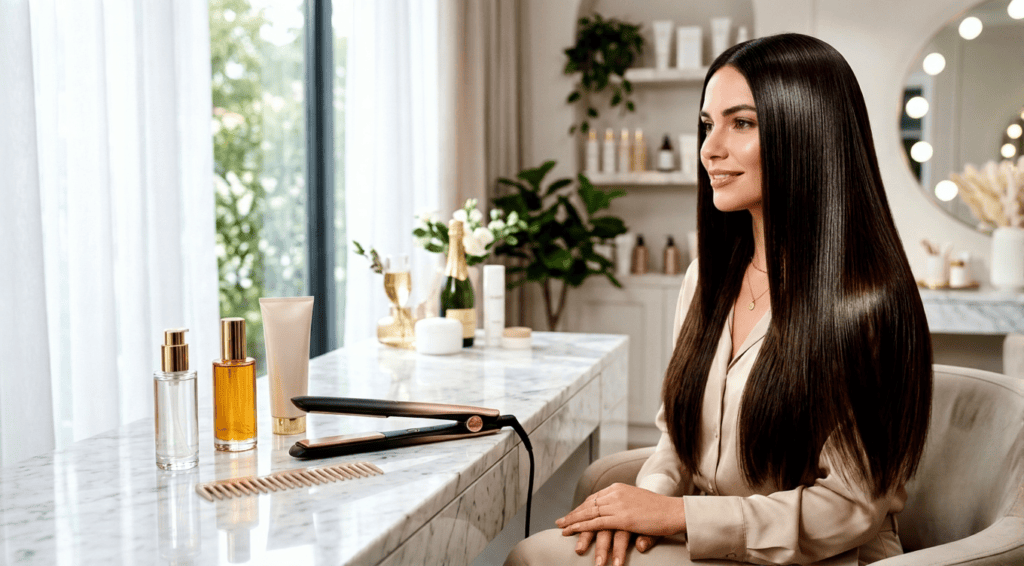
If your feed has turned into an endless scroll of hair so shiny it looks wet even when it’s completely dry, you’ve already met glass hair. It’s the biggest hair trend of 2026, and unlike a lot of viral beauty moments, this one isn’t going anywhere fast. Stylists at London Fashion Week brought it straight to the runway, and it’s been showing up on red carpets and TikTok in equal measure.
The tricky part is that glass hair looks deceptively simple. Smooth, sleek, reflective. But getting that finish at home takes more than running a flat iron over dry strands and hoping for the best. It comes down to what’s happening underneath the shine.
What Exactly Is Glass Hair?
Glass hair describes strands that are so smooth and healthy they reflect light almost like a mirror. Think of the shine you see in an old-school shampoo commercial, except it’s meant to look real, not filtered. The style first gained traction through Korean and Japanese beauty routines before spreading to salons and red carpets worldwide.
What sets it apart from regular “shiny hair” is precision. There’s no frizz, no flyaways, and no rough texture breaking up the light. Every strand lies flat against the next one, which is exactly why it reflects light so evenly.
Why Some Hair Reflects Light and Some Doesn’t
Here’s the part most people skip over: glass hair isn’t really about styling tools. It’s about the cuticle, the outermost layer of each strand.
When the cuticle lies flat, light bounces off it evenly and hair looks glossy. When the cuticle is rough, raised, or damaged from color, heat, or over-washing, light scatters in every direction instead of reflecting back. That scattering is what makes hair look dull, no matter how much serum you pile on.
This is why two people can use the exact same shine spray and get completely different results. If the hair underneath isn’t healthy to begin with, the product is just masking the problem rather than fixing it.
The Four Building Blocks of Glass Hair
Every credible source on this trend circles back to the same four things working together.
1. Bond Repair
Damaged or porous hair won’t reflect light properly no matter what you do to the surface. A weekly bond-building treatment helps restore the internal structure of the hair shaft, which matters most if you color, bleach, or heat style regularly. Products built around bond-repair complexes are worth the extra step here, especially before styling.
2. Deep Hydration
Dry hair absorbs light instead of reflecting it. A hydrating mask or leave-in treatment used consistently, not just before a big event, keeps strands soft enough to lie flat and catch the light properly.
3. Cuticle Smoothing
This is where a clarifying shampoo earns its keep. Product buildup, hard water minerals, and residue all roughen the cuticle over time. Starting with a clean base, followed by a smoothing conditioner, gives the cuticle a fighting chance to lie flat before you even pick up a heat tool.
4. Shine Sealing
The final step is the one people usually think of first: a lightweight serum, gloss spray, or shine-boosting oil applied to damp or dry hair. Ingredients like dimethicone and amodimethicone are common in these formulas because they physically smooth and seal the cuticle rather than just coating it temporarily.
A Simple At-Home Glass Hair Routine
- Wash with a clarifying shampoo once a week to clear buildup, then switch to a smoothing shampoo and conditioner for regular washes.
- Apply a bond-repair treatment before shampooing if your hair is color-treated or frequently heat styled. Once a week is enough for damaged hair; every two to three weeks works for maintenance.
- Detangle gently with a wide-tooth comb while hair is still damp and coated in conditioner.
- Apply a heat protectant that doubles as a smoothing primer before blow-drying. This step does double duty: protecting strands and helping them dry sleeker.
- Blow-dry with a round brush, working in small sections and pulling the brush downward to encourage the cuticle to lie flat.
- Finish with a flat iron on sections no wider than an inch, using a low-to-medium heat setting if your hair is fine or color-treated.
- Seal with a shine serum or gloss spray, running it lightly through mid-lengths and ends. A little goes a long way here.
- Finish with a blast of cool air from your dryer or a cool water rinse to help seal the cuticle before you leave the house.
Does This Work for Curly and Textured Hair?
Yes, though the path looks different. Straight and fine hair types tend to get there faster because the cuticle already sits relatively flat. Curly, coily, and wavy textures usually need a smoothing treatment, blow-dry stretch, or silk press first to achieve the fully sleek version of the look.
That said, glass hair doesn’t have to mean pin-straight. Curls and waves can get the same glassy effect by focusing on definition and shine rather than eliminating texture altogether. A curl-defining gel paired with a shine-boosting oil can create that same reflective quality without a flat iron anywhere in sight.
Salon Treatments That Speed Things Up
If your hair is significantly damaged or you want longer-lasting results, a few professional options are worth knowing about.
| Treatment | What It Does | How Long It Lasts |
|---|---|---|
| Glossing treatment | Adds a semi-permanent layer of shine and can subtly enhance color | 4 to 6 weeks |
| Keratin or smoothing treatment | Reduces frizz and relaxes the hair’s texture for easier styling | 2 to 4 months |
| Bond-building salon service | Repairs internal damage from color or heat, improving how hair reflects light over time | Ongoing, with maintenance |
| Silk press | Blow-dry and flat-iron service designed for curly and coily hair | 1 to 2 weeks, depending on humidity |
At-home styling alone typically holds its shine for a day or two before natural oils and humidity start to soften the effect. Salon treatments buy you more time between routines, but they work best as a supplement to a solid at-home routine, not a replacement for one.
Common Mistakes That Kill the Shine
- Skipping the clarifying step. Buildup from dry shampoo, styling products, and hard water is one of the biggest reasons hair looks dull instead of glassy.
- Using too much product. Piling on serum or oil doesn’t create more shine past a certain point. It just weighs hair down and can make it look greasy instead of glossy.
- Ignoring heat damage. Skipping heat protectant to save time is one of the fastest ways to undo months of bond-repair work.
- Washing in hot water. Hot water lifts the cuticle, which is the opposite of what you want. A cool rinse at the end of your shower helps seal it back down.
- Choosing the wrong texture of serum for your hair type. Fine hair needs a lightweight, almost weightless formula, while coarser or curlier hair can usually handle a richer oil-serum hybrid.
Frequently Asked Questions
What is glass hair?
Glass hair is a hair trend defined by ultra-smooth, high-shine strands that reflect light almost like a mirror. It relies on a flat, healthy cuticle rather than heavy styling products.
How long does glass hair last?
At-home styling usually holds for a day or two, while salon treatments like glossing or keratin smoothing can last several weeks depending on the service and your hair type.
Can curly hair get the glass hair look without straightening?
Yes. Curly and wavy hair can achieve a similar glassy effect by focusing on definition, hydration, and a shine-sealing product rather than fully straightening the texture.
Do I need expensive products to get glass hair?
No. Consistency with the basics, clarifying, hydrating, and sealing the cuticle, matters more than price point. Several affordable drugstore serums and bond-repair products perform close to premium options.
Why does my hair look shiny in the shower but dull once it dries?
Wet hair naturally looks glossier because water temporarily smooths the cuticle. Dullness once dry usually points to product buildup, heat damage, or a cuticle that isn’t sealed properly before styling.
Final Thought
Glass hair looks like a styling trick, but it’s really a health trick wearing a styling trend’s clothes. The people who pull it off consistently aren’t necessarily better at using a flat iron. They’re just not skipping the boring parts: clarifying regularly, repairing bonds before damage piles up, and letting hydration do the work that product alone can’t. Get those basics right, and the shine takes care of itself.