
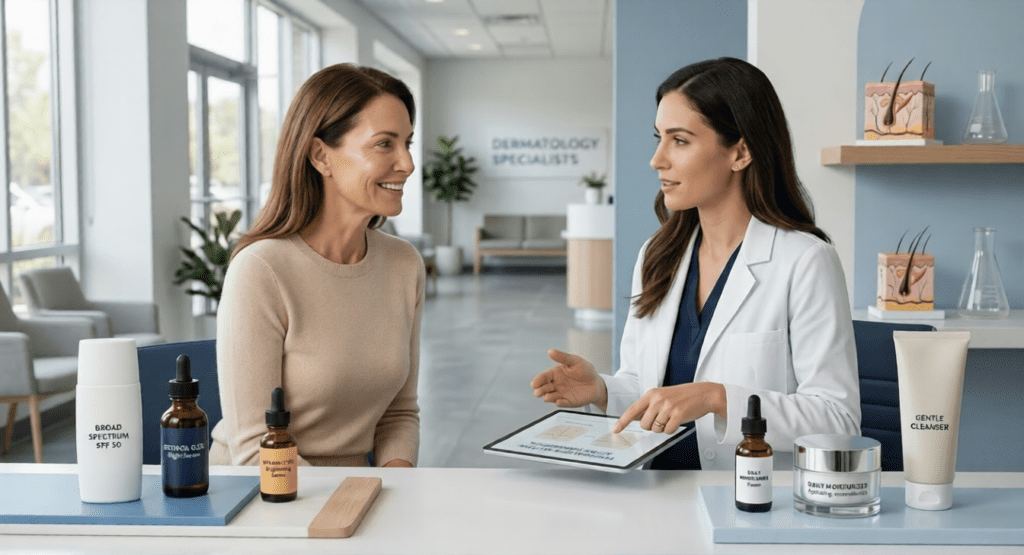
The Anti-Aging Advice You Actually Need to Hear
Walk into any beauty store and you will see hundreds of products all promising to reverse aging, erase wrinkles, and give you back the skin of your twenties. It is overwhelming. It is confusing. And honestly, a lot of it is just really good marketing.
But what do actual dermatologists say? The ones with medical degrees, years of clinical experience, and no incentive to sell you an overpriced cream? Their advice is usually a lot simpler, a lot more science-based, and a lot more affordable than what beauty brands want you to believe.
This blog breaks down exactly what US dermatologists actually recommend for anti-aging skincare. No fluff. No miracle promises. Just real information that works.
First, Let’s Talk About What Actually Causes Skin to Age
Before you can fight something, it helps to understand what you are fighting. Skin aging happens in two ways.
The first is intrinsic aging. This is the natural aging process that happens from the inside. Over time, your skin produces less collagen and elastin. Cell turnover slows down. The skin becomes thinner, drier, and less firm. This is mostly genetic and you cannot fully stop it.
The second is extrinsic aging. This is aging caused by outside factors. Sun exposure, pollution, smoking, poor diet, lack of sleep, and chronic stress all fall into this category. This kind of aging is largely preventable and this is where your skincare routine makes the biggest difference.
Most dermatologists agree that up to 90 percent of visible skin aging is caused by sun damage alone. That one fact changes everything about how you should approach your routine.
What Dermatologists Say Actually Works
1. Sunscreen Is the Most Powerful Anti-Aging Product You Own
Every single dermatologist will put this at the top of the list. Sunscreen is not just for beach days. It is a daily, year-round, non-negotiable step that prevents the kind of damage that causes wrinkles, dark spots, uneven skin tone, and loss of firmness.
UV rays break down collagen. They cause DNA damage in skin cells. They create dark spots that are incredibly hard to fade. And they do all of this silently, without you feeling it in the moment.
Dr. Patricia Farris, a board-certified dermatologist based in Louisiana, has said in multiple interviews that if she could only recommend one anti-aging product it would be sunscreen. Many of her colleagues across the country say the same thing.
What to look for:
- Broad-spectrum protection, which means it covers both UVA and UVB rays
- SPF 30 at minimum, SPF 50 for better protection
- A formula you will actually wear every day, whether that is a lightweight fluid, a tinted moisturizer with SPF, or a standalone sunscreen
Apply it every single morning as the last step before makeup. Reapply every two hours if you are spending time outdoors.
2. Retinoids Are the Gold Standard in Anti-Aging
If sunscreen is number one, retinoids are a very close number two. Retinoids are vitamin A derivatives and they are one of the most studied, most proven anti-aging ingredients in dermatology.
They work by speeding up cell turnover, stimulating collagen production, smoothing fine lines, fading dark spots, and improving overall skin texture. The research behind retinoids spans decades and the evidence is genuinely impressive.
There are different forms available at different strengths. Prescription tretinoin is the strongest and most studied. Over the counter retinol is gentler and takes longer to show results but is still effective with consistent use. Retinaldehyde sits in between the two in terms of strength.
Tips dermatologists give for starting retinoids:
Start slow. Use it two to three times a week at first and gradually increase. Your skin needs time to adjust.
Always apply at night. Retinoids can make your skin more sensitive to sunlight.
Moisturize well. Retinoids can cause dryness and flaking, especially in the beginning. A good moisturizer helps.
Be patient. Real results take three to six months of consistent use. Most people give up too early.
3. Vitamin C in the Morning Is a Game Changer
Vitamin C is an antioxidant that dermatologists genuinely love. It protects the skin from free radical damage caused by UV rays and pollution, brightens the complexion, fades hyperpigmentation, and supports collagen production.
The key is using it in the morning, layered underneath your sunscreen. The combination of vitamin C and sunscreen gives your skin double protection against sun damage.
What to look for:
L-ascorbic acid is the most potent and well-researched form of vitamin C but it can be irritating for sensitive skin. Look for concentrations between 10 and 20 percent. If your skin is sensitive, try vitamin C derivatives like ascorbyl glucoside or sodium ascorbyl phosphate, which are gentler but still effective.
Store your vitamin C serum in a cool, dark place. Vitamin C oxidizes when exposed to light and air and loses its effectiveness.
4. Niacinamide Does More Than Most People Realize
Niacinamide is a form of vitamin B3 and it has become one of dermatology’s most praised multi-tasking ingredients. It minimizes the appearance of pores, reduces redness, fades dark spots, improves skin texture, and strengthens the skin barrier.
What makes niacinamide especially valuable from a dermatologist’s perspective is how well it tolerates different skin types. Unlike retinoids or vitamin C, niacinamide is gentle enough for sensitive skin and does not require a slow introduction period.
It also works well alongside most other ingredients in your routine, which makes it easy to slot in without worrying about interactions.
5. A Strong Skin Barrier Is the Foundation of Everything
One thing dermatologists talk about constantly is the skin barrier. Your skin barrier is the outermost layer of your skin and its job is to keep moisture in and irritants out. When it is healthy, your skin looks plump, calm, and radiant. When it is damaged, your skin looks dull, feels tight, reacts easily, and ages faster.
A huge number of people are unknowingly damaging their skin barrier by over-exfoliating, using too many active ingredients at once, washing their face with hot water, or using products with a lot of fragrance or alcohol.
What dermatologists recommend for barrier health:
- Use a gentle, fragrance-free cleanser that does not strip the skin
- Do not exfoliate more than two to three times per week
- Use a moisturizer with ceramides, which help rebuild and reinforce the barrier
- Avoid layering multiple strong actives without giving your skin time to adjust
6. Peptides Support Collagen Without the Irritation
Peptides are short chains of amino acids that act as building blocks for collagen and elastin. When applied topically, they signal the skin to produce more of its own collagen, which leads to firmer, smoother skin over time.
Dermatologists like peptides because they are effective but gentle. They do not cause the adjustment period that retinoids do and they are suitable for almost every skin type including sensitive skin.
Peptide serums and moisturizers work especially well when combined with other anti-aging ingredients. They are a great addition to a routine that already includes retinoids and vitamin C.
7. Hyaluronic Acid Keeps Skin Looking Plump and Young
One of the most visible signs of aging is the loss of volume and plumpness in the skin. Hyaluronic acid helps address this by drawing moisture into the skin and holding it there.
It is a naturally occurring substance in the body but levels decrease as we age. Topical hyaluronic acid cannot fully replace what the body loses but it does a very good job of keeping the skin hydrated, which directly impacts how youthful it looks.
How to get the most out of hyaluronic acid:
Apply it to slightly damp skin and follow immediately with a moisturizer. Hyaluronic acid needs moisture to work with. If you apply it to completely dry skin in a dry environment, it can actually pull moisture from deeper layers of the skin, which is the opposite of what you want.
8. Do Not Skip Eye Cream
The skin around your eyes shows signs of aging earlier than anywhere else on your face. It is the thinnest skin on the body, it lacks oil glands to keep it hydrated naturally, and it moves constantly with every blink and expression you make.
Dermatologists recommend using a dedicated eye cream rather than extending your regular face moisturizer to that area. Eye creams are formulated specifically for the sensitivity and needs of the eye area.
Look for retinol in a lower concentration for fine lines and crow’s feet, caffeine for puffiness and dark circles, peptides for firmness, and hyaluronic acid for hydration.
Apply with your ring finger using a gentle tapping motion. Never rub or pull the eye area.
9. Your Neck and Chest Need the Same Attention
This is something dermatologists bring up constantly and most people completely ignore. The neck and chest are exposed to the same sun and environmental damage as your face but they almost never get the same skincare attention.
The neck in particular has thinner skin and fewer oil glands than the face, which makes it even more vulnerable to showing early signs of aging. Horizontal lines on the neck, often called tech neck lines, are becoming increasingly common.
Whatever you are doing to your face, bring it down to your neck and chest. Cleanse, apply serums, moisturize, and always apply sunscreen to these areas too.
10. Lifestyle Factors Are Not Optional
This is the part that does not involve buying anything but dermatologists will not let it go unmentioned because it genuinely matters.
Sleep. Your skin repairs itself while you sleep. Growth hormone, which helps with cell turnover and collagen production, is primarily released during deep sleep. People who consistently sleep less than seven hours tend to show more visible signs of aging over time. Sleep on a silk or satin pillowcase to reduce friction and compression wrinkles.
Diet. What you eat shows up on your skin. A diet high in refined sugar promotes glycation, a process that breaks down collagen and speeds up aging. Antioxidant-rich foods like berries, leafy greens, and fatty fish support skin health from the inside out.
Hydration. Drinking enough water keeps skin cells plump and functioning properly. It is not a substitute for topical skincare but it is a foundation that everything else builds on.
Stress management. Chronic stress raises cortisol levels, which breaks down collagen, slows skin repair, and worsens skin conditions like acne and eczema. Managing stress is genuinely part of an anti-aging strategy.
Smoking. If there is one lifestyle factor that ages skin faster than almost anything else, it is smoking. It restricts blood flow to the skin, breaks down collagen and elastin, and causes the pursed-lip wrinkles around the mouth. Dermatologists are very direct about this one.
The Anti-Aging Routine Dermatologists Actually Build
Here is what a dermatologist-approved anti-aging routine looks like in practice:
Morning:
- Gentle cleanser
- Vitamin C serum
- Niacinamide serum (optional, works well with vitamin C)
- Eye cream
- Moisturizer with ceramides
- Broad-spectrum SPF 30 to 50
Evening:
- Oil cleanser to remove sunscreen and makeup
- Gentle water-based cleanser
- Retinoid (two to three times a week to start, build up from there)
- Peptide serum or hyaluronic acid serum on nights without retinoid
- Eye cream
- Rich moisturizer or barrier-repair cream
Ingredients to Be Skeptical About
Dermatologists are honest about the fact that not every trending ingredient lives up to its marketing. A few things worth knowing:
Collagen in creams and serums. Collagen molecules are too large to penetrate the skin’s surface. Products that claim to add collagen topically are not doing what the label implies. Ingredients that stimulate your own collagen production, like retinoids and peptides, are far more effective.
“Stem cell” products. Most of these contain plant stem cells, not human stem cells, and the evidence for their effectiveness is very limited. The term sounds impressive but the science is not there yet.
Anything that promises results in days. Genuine structural changes in the skin take weeks to months. If something claims to visibly reduce wrinkles in 48 hours, it is most likely using ingredients that temporarily plump or blur the skin rather than actually changing anything.
How Much Should You Actually Spend?
Here is something refreshing that dermatologists say. The most important products in your anti-aging routine, sunscreen and a retinoid, do not need to be expensive.
Drugstore sunscreens with broad-spectrum protection work just as well as luxury options. Generic tretinoin from a dermatologist or telehealth platform is the same molecule as expensive prescription retinoid brands. CeraVe, Neutrogena, and La Roche-Posay consistently show up on dermatologist recommendation lists and none of them cost a fortune.
Where price does sometimes matter is in formulation quality, especially for vitamin C serums, which need to be properly stabilized to remain effective. But even there, mid-range options often perform just as well as luxury prices.
The Honest Truth About Anti-Aging Skincare
Skincare can do a lot. It can protect your skin from future damage, improve texture, fade dark spots, support collagen production, and keep your skin looking healthy and vibrant for longer.
But skincare cannot fully reverse decades of sun damage overnight. It cannot eliminate deep-set wrinkles with a single product. And it cannot replace the foundational habits like sleep, diet, and sun protection that have been accumulating since your teenage years.
The good news is that it is never too late to start. Dermatologists see meaningful improvements in patients who build a consistent routine in their 40s, 50s, and beyond. The skin responds to care at every age.
Start with the basics. Be consistent. Be patient. And stop spending money on products that promise the impossible.