
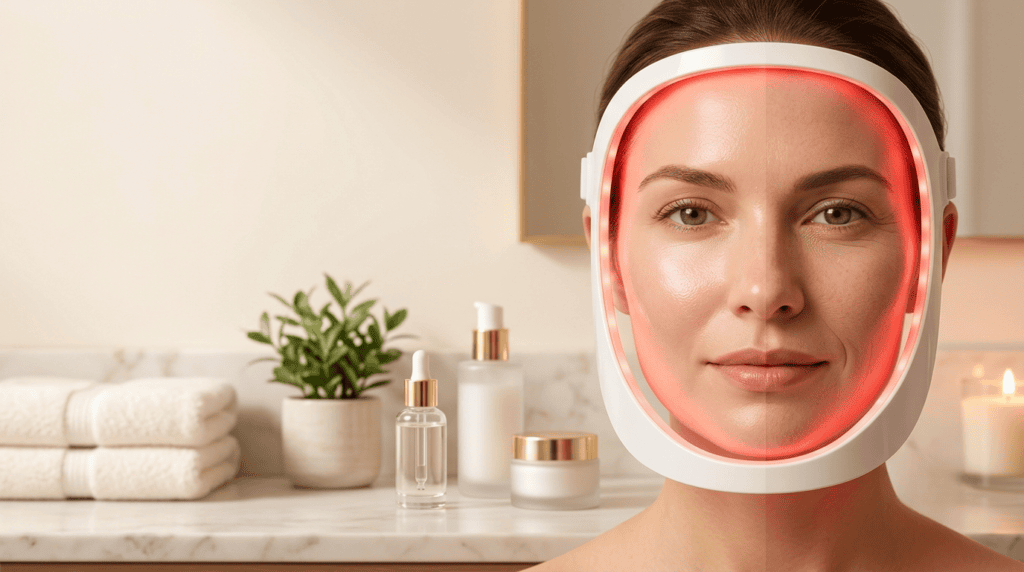
Scroll through any skincare aisle of the internet and you’ll find someone glowing under a red LED mask, claiming it changed their skin in weeks. Red light therapy has gone from dermatology-office equipment to a bathroom-counter staple, and the marketing promises are big: smoother skin, fewer wrinkles, more collagen, all without needles or downtime.
The honest answer is more nuanced than the ads suggest. Red light therapy does have real science behind it. It also has real limits, and “erase” is not a word any dermatologist would use in good conscience. Here’s what’s actually going on under your skin when you flip that mask on.
What Red Light Therapy Actually Is
Red light therapy, also called photobiomodulation or low-level laser therapy, uses specific wavelengths of red and near-infrared light to trigger changes inside skin cells. It’s not a heat treatment and it doesn’t involve UV rays, which is why it’s considered low-risk compared to sun exposure or laser resurfacing.
The mechanism researchers point to most often involves mitochondria, the energy-producing structures inside your cells. Red and near-infrared light appears to stimulate mitochondrial activity, which in turn supports fibroblasts, the cells responsible for producing collagen and elastin. Collagen is what keeps skin firm; elastin is what lets it snap back into place. Less of both is a big part of why skin sags and wrinkles with age.
Devices typically use wavelengths somewhere in the 630–670 nanometer range for red light and 800–850 nanometers for near-infrared, since these penetrate the skin at different depths. Red light works mostly at the surface; near-infrared reaches deeper into the dermis.
What the Research Actually Shows
This is where things get more interesting, because the evidence isn’t just marketing talk.
A randomized controlled trial published in the Journal of Photobiomodulation, Photomedicine, and Laser Surgery found that participants using 633nm and 830nm LED therapy over several weeks showed statistically significant reductions in periorbital wrinkle depth, along with improved skin roughness scores and higher dermal collagen density confirmed through tissue analysis. That’s a meaningfully strong result for a non-invasive, at-home-compatible treatment.
But timing matters more than most people expect. Clinical studies generally show visible improvements in skin texture and wrinkle depth after 8 to 12 weeks of consistent use, not after a handful of sessions. Multiple industry sources echo this: a 2023 study on facial skin aging found gradual improvements in smoothness, elasticity, and overall appearance built up over repeated sessions rather than showing up immediately, which lines up with how collagen remodeling naturally works in the body.
That patience requirement is also where a lot of home users lose interest. It’s much easier to buy a mask than to use it daily for two to three months straight.
It’s worth noting that not every part of the evidence base is equally strong. A broader review of the research points out that much of the home-device evidence still comes from smaller open-label studies or trials that combine red light with other treatments, rather than large-scale trials testing red light alone. That doesn’t mean the treatment doesn’t work. It means the “clinically proven” claims on some product pages are doing more work than the underlying data can fully support.
General health resources take a similarly measured stance: research indicates red light therapy may smooth skin and help with wrinkles, largely by stimulating collagen production that supports skin elasticity, along with improvements in signs of sun damage. Notice the “may” — that’s accurate hedging, not corporate caution.
So Does It Erase Wrinkles?
No. Nothing marketed as a home device erases wrinkles, and any product claiming otherwise is overselling. What red light therapy can realistically do, based on the current evidence, is:
- Soften the appearance of fine lines over consistent use
- Improve skin texture and roughness
- Support collagen density in the upper layers of skin
- Modestly improve tone and reduce redness
It will not remove deep static wrinkles, fix significant sagging, or replace what injectables, retinoids, or in-office laser treatments can do. Think of it as a slow, cumulative maintenance tool rather than a fix.
At-Home Devices vs. In-Clinic Treatment
This distinction matters because it directly affects your expectations.
Home red light devices are generally less powerful than the equipment used in clinics, which means they may take longer to show results or produce a smaller effect overall. Clinical-grade panels deliver higher irradiance in a single session, which is part of why in-office photobiomodulation can sometimes show change faster.
That doesn’t make home devices pointless. It means home use is a long game: shorter sessions, done more often, over a longer stretch of time.
| Factor | At-Home Devices | In-Clinic Treatment |
|---|---|---|
| Power output | Lower, gentler exposure | Higher irradiance per session |
| Session length | 3–20 minutes | Often longer, supervised |
| Cost | One-time purchase, $150–$600+ | Per-session fee, adds up over time |
| Convenience | Use on your own schedule | Requires appointments |
| Time to results | 8–12 weeks of consistent use | Can be faster, fewer sessions needed |
| Best for | Maintenance, prevention, mild concerns | More visible or advanced skin aging |
Types of At-Home Devices
There isn’t just one kind of red light gadget, and the format you pick changes how practical it is to use consistently.
LED face masks wrap around your entire face and deliver even coverage in one go. These are designed to be worn for short sessions several times a week and are commonly used for wrinkles, acne, and other facial concerns. This is the most popular category right now because it requires the least effort — you put it on and go about your evening.
Handheld wands and panels let you target specific areas like the eyes or forehead, but they demand more hands-on time since you’re moving the device yourself.
Full-body panels or beds are the least practical for home use, mostly showing up in gyms, spas, or dedicated wellness spaces rather than bathrooms.
For wrinkle-specific goals, masks with both red and near-infrared wavelengths tend to be favored, since testers evaluating leading masks noted that models offering red, near-infrared, deep red, and amber settings could address fine lines, redness, discoloration, and dullness in the same session.
What to Look For Before Buying
Not every red light mask on the market is built the same, and price doesn’t always track with quality. A few things are worth checking before you spend:
- FDA clearance. This doesn’t guarantee dramatic results, but it does mean the device met a baseline safety and performance standard.
- Wavelength range. Look for something in the 630–670nm and 800–850nm zones if wrinkles are your main concern.
- LED count and coverage. More LEDs generally mean more even light distribution across the face, though this isn’t the only factor that matters.
- Session length and consistency needs. A device you’ll actually use three or four times a week beats a “more powerful” one that ends up in a drawer.
- Return policy and warranty. Given the price range, a generous trial window is a meaningful buffer if the device doesn’t suit your skin or routine.
Reviewers testing the current crop of masks in 2026 have flagged a wide spread in build quality even among similarly priced options — some budget-friendly FDA-cleared masks have drawn criticism over battery reliability and app glitches, while pricier models have been dinged by dermatology communities for questionable value relative to their claims. Reading independent reviews, not just brand pages, is worth the extra ten minutes before checkout.
Is It Safe?
For most people, yes. Red light therapy doesn’t use UV light, so it doesn’t carry the skin-cancer risks associated with tanning beds. Side effects are uncommon and usually mild, like temporary redness or dryness. People on certain photosensitizing medications, or those with a history of skin cancer, should check with a dermatologist first, simply as a precaution rather than because of documented widespread risk.
Pregnant women and anyone with an active skin condition, like an infection or open wound in the treatment area, should also get a doctor’s go-ahead before starting.
Realistic Expectations for At-Home Use
If you’re going in expecting a dramatic before-and-after in two weeks, you’ll likely be disappointed and stop using the device before it’s had a chance to do anything. If you’re going in expecting a gradual, subtle improvement in texture and fine lines over two to three months of near-daily use, you’re working with the evidence rather than against it.
Red light therapy pairs well with, rather than replaces, the basics: sunscreen, retinoids, hydration, and sleep. Skipping those and hoping a mask alone will undo years of sun damage is where most disappointment comes from.
Who Should Try It
- Anyone in their late 20s to 40s looking for a preventive, low-risk addition to their skincare routine
- People with mild to moderate fine lines who want a gradual improvement without injectables
- Those already following a solid skincare routine who want to add one more evidence-backed step
Who Should Skip It
- Anyone expecting fast, dramatic results comparable to Botox or laser resurfacing
- People unwilling to commit to consistent use for at least two to three months
- Those with deep, static wrinkles that are more structural than surface-level
FAQs
Does red light therapy really reduce wrinkles?
It can help soften the appearance of fine lines and improve skin texture with consistent use over 8 to 12 weeks, based on clinical research. It won’t erase deeper, more established wrinkles.
How often should I use a red light therapy mask?
Most devices are designed for 3 to 20 minute sessions, three to five times a week. Check your specific device’s instructions, since power and recommended frequency vary by brand.
How long until I see results?
Most clinical studies show visible changes after 8 to 12 weeks of regular use, not after a few sessions. Some people notice improvements in glow or tone earlier, but structural changes take longer.
Is red light therapy better than retinol for wrinkles?
They work differently and aren’t direct substitutes. Retinol speeds up cell turnover chemically, while red light stimulates collagen production through light exposure. Many dermatologists suggest using both together rather than choosing one.
Are expensive red light masks actually better than cheaper ones?
Not always. Price often reflects brand and design rather than proven results. FDA clearance, wavelength range, and independent reviews matter more than the price tag alone.
Final Thoughts
Red light therapy isn’t a gimmick, but it isn’t magic either. The science behind it is real, the collagen response is measurable, and dermatologists genuinely recommend it as part of a broader routine. What it won’t do is replace sunscreen, undo years of sun damage overnight, or match the speed of a needle or a laser.
If you’re patient enough to use a mask consistently for two to three months and you’re pairing it with the basics your skin already needs, it’s a reasonable, low-risk addition to your routine. If you’re hoping for a quick fix before an event next week, your money is better spent elsewhere.