
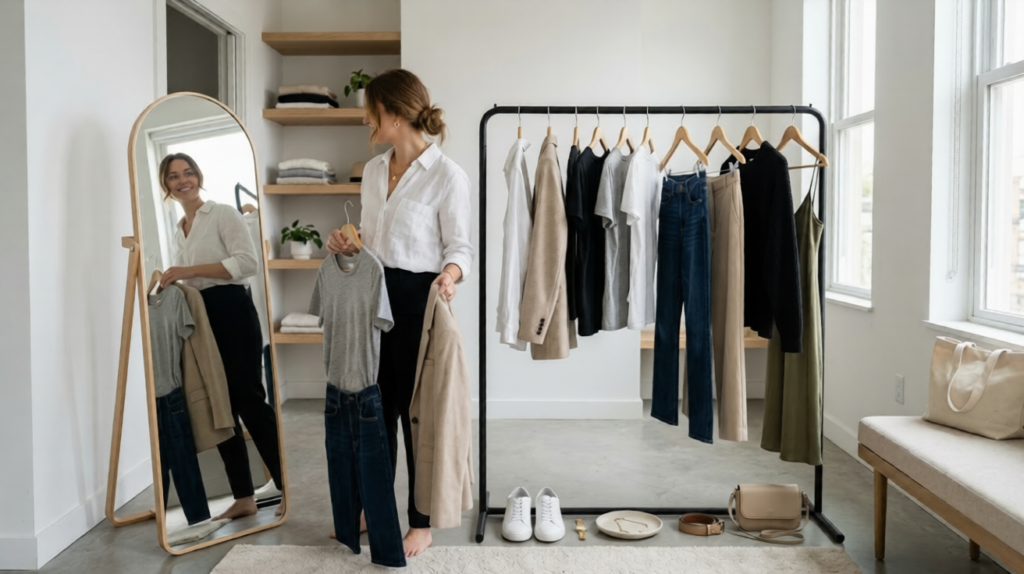
You Have a Full Closet and Nothing to Wear. Sound Familiar?
Most people own more clothes than they have ever owned in their lives and yet they stand in front of their closet every single morning feeling like they have absolutely nothing to wear.
That is not a shopping problem. That is a strategy problem.
The capsule wardrobe concept fixes exactly this. It is not about owning as few things as possible or dressing like a monk. It is about owning the right things. Pieces that actually work together, that fit you well, that match your lifestyle, and that you genuinely reach for again and again.
In 2026, the capsule wardrobe has evolved beyond the basic beige-and-white minimalist aesthetic that floated around Pinterest for years. It is smarter, more personal, and more intentional than ever. And it does not require a huge budget to pull off.
This guide walks you through everything you need to know to build one that actually works for your real life.
What Is a Capsule Wardrobe, Really?
The term was first coined by London boutique owner Susie Faux in the 1970s. The idea was simple. A small collection of high-quality, timeless pieces that could be mixed and matched to create a wide variety of outfits.
Donna Karan brought the concept mainstream in 1985 with her famous “Seven Easy Pieces” collection. Since then, it has been redefined and adapted by minimalists, stylists, and fashion lovers in every decade.
In 2026, a capsule wardrobe is not a rigid formula. It is a personal system. The goal is to build a closet where almost every item works with almost every other item, where you always have something to wear, and where getting dressed takes five minutes instead of forty-five.
The magic number most stylists land on is somewhere between 30 and 50 pieces total, including tops, bottoms, dresses, outerwear, and shoes. But that number is flexible. What matters more than the count is the quality of each piece and how well everything works together.
Why the Capsule Wardrobe Is More Relevant Than Ever in 2026
A few things have happened in recent years that make the capsule wardrobe approach feel more urgent than ever.
Fast fashion fatigue is real. People are increasingly aware of what overconsumption does to their wallets, their mental space, and the environment. The idea of buying less but buying better has moved from niche to mainstream.
Micro-trends are exhausting. Social media in 2026 churns through trends faster than ever. Something blows up on TikTok, gets called the next big thing, disappears in six weeks, and then shows up in a secondhand store a year later. Chasing micro-trends is expensive and unsatisfying.
Cost of living pressures are real. With prices staying elevated across the board, people are being more strategic about where their money goes. A well-built capsule wardrobe is actually one of the most cost-effective approaches to dressing well over time.
The “buy once, buy right” mindset is growing. More and more people are recognizing that spending more on one quality item that lasts five years is smarter than buying five cheap versions of it that fall apart.
Step One: Audit What You Already Own
Before you buy a single thing, you need to know what you are working with.
Pull everything out of your closet and drawers. Everything. Lay it all out where you can see it.
Now go through it honestly and sort into three piles.
Keep. These are pieces you actually wear, that fit you properly right now, that make you feel good, and that work with other things you own.
Maybe. These are pieces you are unsure about. Set these aside and come back to them at the end. Often by the time you have clarity on your keep pile, the maybe pile becomes much easier to sort.
Let go. Anything that does not fit, that you have not worn in over a year, that you only kept out of guilt, or that simply does not feel like you anymore.
Be ruthless here. The whole point of a capsule wardrobe is that every piece earns its place. Sentimental clutter and optimistic shopping mistakes take up space and make your closet harder to use.
Donate, sell, or give away what you are letting go of. Then take a clear look at what is left in your keep pile. This is your foundation.
Step Two: Define Your Actual Lifestyle
This is the step most capsule wardrobe guides skip and it is the reason a lot of people end up with a capsule that looks great on paper but does not work in real life.
Your wardrobe needs to match your life, not someone else’s aesthetic on Pinterest.
Ask yourself honestly how you actually spend your days. If you work from home five days a week, you do not need ten formal blazers. If you live in a cold climate, you need more layering pieces than someone in a warm one. If you travel frequently, packability and wrinkle resistance matter. If you have young kids, dry-clean-only silk is probably not serving you.
Break your life down roughly into categories and estimate what percentage of your time you spend in each. Something like work, casual daily life, social outings, active or athletic, and special occasions works for most people.
Your capsule should be weighted toward how you actually live. If 70 percent of your life is casual, 70 percent of your wardrobe should be casual pieces that make you look and feel great.
Step Three: Choose Your Color Palette
This is where the mix-and-match magic comes from. A capsule wardrobe works because the pieces talk to each other. And the easiest way to make that happen is to work within a cohesive color palette.
Most stylists recommend building your capsule around two or three neutral base colors and one or two accent colors.
Neutral base options: white, cream, beige, camel, navy, grey, black, brown, olive
Accent color options: burgundy, forest green, rust, cobalt, terracotta, blush, mustard
The goal is to choose colors that feel natural on you, that you already gravitate toward, and that genuinely work together. When every piece in your wardrobe shares a color language, almost every combination becomes an outfit.
One practical tip. Look at the pieces in your keep pile from the audit. What colors keep showing up? What colors do you actually feel good in? Let your existing preferences guide you rather than following what looks good on someone else.
Step Four: Build Your Foundation Pieces
These are the non-negotiables. The pieces that form the backbone of your capsule and show up in outfit after outfit.
Tops
A few well-fitting white or neutral t-shirts are essential. Not the thin, see-through kind. A quality cotton t-shirt that holds its shape and looks intentional.
A crisp button-down shirt in white or light blue is endlessly versatile. It works under sweaters, open over a tank, tucked into trousers, or half-tucked into jeans.
One or two fitted crewneck or V-neck sweaters in your neutral palette. These are your layering workhorses.
A quality fitted turtleneck if you live in a cooler climate.
Bottoms
A pair of well-fitted dark wash jeans that you feel genuinely good in. Not just okay in. Good in.
A pair of tailored trousers in a neutral like grey, black, camel, or navy. These instantly elevate any top they are paired with.
One casual trouser or wide-leg pant in a relaxed fit for everyday wear.
A midi or knee-length skirt if that is part of your style.
Dresses
One casual dress that works for everyday wear. This could be a shirt dress, a wrap dress, or a simple slip dress depending on your preference.
One slightly more elevated dress for occasions when you need to look pulled together without overthinking it.
Outerwear
A classic trench coat is one of the most universally flattering and versatile pieces you can own. It works over almost everything and in almost every weather.
A well-fitting blazer in a neutral. This is the single easiest way to make any casual outfit look more intentional.
A casual everyday jacket, whether that is a denim jacket, a bomber, or a casual wool coat, depending on your climate.
Shoes
A clean white or neutral sneaker that goes with almost everything.
A pair of ankle boots or low-heeled boots in a dark or tan leather.
A simple flat sandal or loafer for warmer months or casual days.
One slightly more elevated heel or dressy shoe for occasions.
Step Five: Add Your Accent Pieces
This is where your personality comes in. Once your foundation is solid, you add a small number of pieces that bring color, texture, or interest to your outfits.
This might be a rust-colored knit sweater, an olive green utility jacket, a printed scarf, or a statement bag in an accent color. These are the pieces that make an outfit feel like yours and not just a generic minimalist formula.
Keep this section small. Five to eight pieces is plenty. The foundation does the heavy lifting. The accents just add life.
Step Six: The Role of Accessories in a Capsule Wardrobe
Accessories are one of the most overlooked and most powerful parts of a capsule wardrobe. The right accessories can make the same base outfit feel completely different from one day to the next.
A simple gold or silver chain necklace that works with everything. A quality leather belt in a color that ties into your palette. A tote bag that is big enough for real life and polished enough to look intentional. A structured crossbody or shoulder bag for times when you want something smaller.
Scarves are especially worth investing in. A quality scarf in a print or color can be worn in the hair, around the neck, tied to a bag, or used as a light wrap and instantly adds dimension to any outfit.
Keep your accessories edited. A small number of versatile, quality pieces will serve you far better than a jumbled drawer full of things you never reach for.
What to Look for When Buying New Pieces
When you have gaps to fill in your capsule, shopping becomes a completely different experience. You are not browsing for entertainment. You are looking for specific things that meet specific criteria.
Fit first, always. A cheap piece that fits perfectly will look better than an expensive piece that does not. If something does not fit off the rack, factor in alteration costs before you decide it is worth it.
Fabric quality matters more than brand. Natural fibers like cotton, wool, linen, silk, and cashmere generally look better, wear better, and last longer than synthetics. Check the fabric content on the label before you buy.
Ask the cost-per-wear question. A forty-dollar shirt you wear once is more expensive than a hundred-and-twenty-dollar shirt you wear three times a week for three years. Think in terms of total value over time, not just the upfront price.
The one-in-one-out rule. Every time a new piece enters your capsule, something else should leave. This keeps the closet from creeping back into chaos over time.
Wait before you buy. If you see something you like, wait at least 48 hours before purchasing. Most impulse buys lose their appeal quickly. If you are still thinking about something two days later, it is worth considering.
Capsule Wardrobe Mistakes to Avoid
Buying everything in beige because it looks good in flat lays. Your capsule needs to work for your actual complexion and lifestyle, not for Instagram aesthetics. If you look washed out in cream, cream is not a neutral for you.
Ignoring comfort. If you do not feel comfortable in something, you will not wear it. Comfort and style are not opposites. The best pieces deliver both.
Going too minimal too fast. Stripping your wardrobe down to 20 pieces overnight can leave you feeling restricted and frustrated. Build slowly, thoughtfully, and in a way that feels good to live in.
Forgetting about care. A capsule wardrobe only works if you actually maintain the pieces. Learn how to care for your fabrics properly. Quality pieces last significantly longer with the right care.
Treating it as done. Your capsule is a living system. Your lifestyle changes, your taste evolves, your body changes. Revisit and refine it every six months or so to make sure it still reflects your real life.
A Simple Capsule Wardrobe Starter List for 2026
If you are starting mostly from scratch, here is a realistic starting point. These numbers are flexible based on your lifestyle:
Tops: 2 quality t-shirts, 2 button-down shirts, 2 knit sweaters, 1 turtleneck, 1 to 2 casual tanks or camis
Bottoms: 2 pairs of jeans in different washes, 1 pair of tailored trousers, 1 casual trouser or wide leg, 1 skirt
Dresses: 1 casual everyday dress, 1 elevated dress
Outerwear: 1 trench coat, 1 blazer, 1 casual jacket
Shoes: 1 white or neutral sneaker, 1 ankle or knee boot, 1 flat sandal or loafer, 1 elevated heel or dressy flat
Bags: 1 everyday tote, 1 crossbody or structured shoulder bag
Accessories: 2 to 3 scarves, 1 quality belt, 2 to 3 simple jewelry pieces
Total: Roughly 30 to 40 pieces. Enough to dress well every day without any of the overwhelm.
The Mindset Shift That Makes It All Work
Building a capsule wardrobe is not just a closet project. It is a shift in how you think about clothing and consumption.
When you stop shopping reactively and start shopping intentionally, something changes. You stop feeling that low-level background anxiety about having nothing to wear. You stop wasting Saturday mornings trying on everything you own. You stop feeling guilty about impulse purchases that never work out.
Instead, getting dressed becomes simple and even enjoyable. You open your closet, everything fits, everything works together, and you walk out the door feeling like yourself.
That is the real promise of a capsule wardrobe. Not looking like a fashion minimalist. Not following a rigid system. Just having a closet that works for you, every single day.